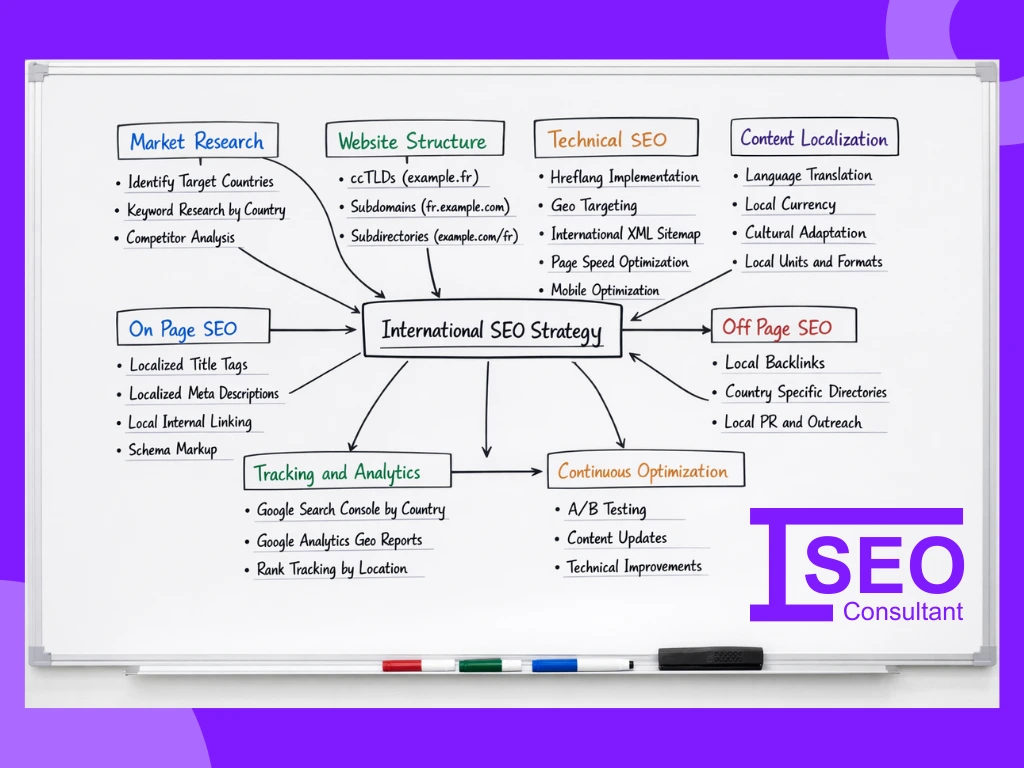
International SEO is the process of optimizing a website so that it can rank in search results across multiple countries and languages. As businesses expand beyond their domestic markets, reaching international audiences through search engines becomes an essential part of digital growth. A well-planned international SEO strategy ensures that users from different regions can easily discover the most relevant version of a website based on their language, location, and search intent.
Global businesses face unique challenges when targeting multiple markets. These include differences in language, cultural context, search behavior, and even the search engines people use. For example, while Google dominates search in many countries, other regions may rely on alternatives such as Baidu or Yandex. Because of this, international SEO requires a broader strategy than traditional SEO.
A successful global SEO strategy typically includes geographic targeting, multilingual content, technical implementation such as hreflang tags, and localized keyword research. When implemented correctly, international SEO helps businesses reach customers worldwide, improve search visibility in multiple regions, and build a strong global digital presence.
International SEO refers to the practice of optimizing a website so search engines can identify which countries and languages the website is targeting. It allows businesses to deliver the right content to the right audience based on geographic location and language preferences.
Unlike standard SEO, which usually focuses on ranking within a single market, international SEO involves optimizing content, technical structure, and website signals for multiple regions. This ensures that users in different countries are directed to the most relevant version of a website.
Definition of International SEO
International SEO is the process of structuring and optimizing a website so that search engines can easily determine the geographic and linguistic audience it serves. This involves creating localized content, implementing language and regional targeting signals, and ensuring the website architecture supports multiple markets.
The goal of international SEO is to help businesses rank in search results across different countries while delivering localized experiences that match the needs and expectations of users in each region.
How International SEO Works
Search engines determine which version of a website to display to users by analyzing several geographic and language signals. These signals help them understand which country or language a page is intended for.
Common signals used in international SEO include:
- Domain structure: Country-specific domains or regional directories indicate geographic targeting.
- Language tags: Technical elements such as hreflang tags inform search engines about language and regional variations.
- Backlinks: Links from websites within a specific country can signal geographic relevance.
- Content language: The language used within page content helps search engines determine the intended audience.
- User location: Search engines also consider the searcher's location when determining relevant results.
By combining these signals, search engines can serve the most appropriate page to users based on their language and region.
Examples of International SEO
Many global companies rely on international SEO to reach audiences in different countries. These organizations create localized versions of their websites that cater to the needs of specific markets.
Examples include:
- Global eCommerce websites that provide country-specific product pages, pricing, and shipping information.
- Software-as-a-Service (SaaS) companies that offer multilingual product pages and localized support resources.
- Multinational corporations that maintain separate regional websites for different markets.
- Online service providers that create country-specific landing pages targeting international customers.
In each case, international SEO ensures that users are directed to the version of the website that best matches their language and geographic location.
Why International SEO Is Important
As businesses grow and enter new markets, reaching customers in different countries becomes a key factor for success. International SEO enables companies to increase their online visibility beyond domestic search results and connect with global audiences.
A well-implemented international SEO strategy can significantly improve global brand awareness, attract new customers, and create opportunities for long-term growth in international markets.
Expanding Into New Global Markets
One of the main advantages of international SEO is the ability to reach potential customers in new geographic regions. By optimizing content and website structure for different countries, businesses can appear in local search results where their products or services are relevant.
This approach allows companies to enter international markets more effectively by aligning their digital presence with the needs and preferences of local users.
Increasing International Organic Traffic
Ranking in search results across multiple countries can significantly increase a website’s organic traffic. Each new region represents an additional audience segment that may search for products, services, or information related to a business.
When international SEO is implemented correctly, businesses can generate consistent traffic from multiple countries rather than relying on a single market.
Building Global Brand Authority
International search visibility helps strengthen a brand’s reputation and credibility worldwide. When users consistently encounter a brand in search results across different countries, it reinforces trust and recognition.
A strong international SEO presence also signals to search engines that a brand has relevance and authority in multiple markets, which can further improve rankings and long-term visibility.
How Search Engines Handle International Websites
Search engines analyze a variety of signals to determine which country and language a website is targeting. When a website serves users from multiple regions, search engines must identify the most relevant version of a page to display in search results. This process helps ensure that users see content that matches their language preferences and geographic location.
To accomplish this, search engines evaluate several factors including domain structure, language signals, backlinks, server information, and user behavior. These signals help them understand whether a page is intended for a specific country, region, or global audience.
For example, if a website has multiple language versions of the same page, search engines must determine which version should appear for users in different countries. Proper international SEO implementation ensures that the correct page appears in the appropriate search results.
Country Targeting Signals
Search engines rely on several signals to determine the geographic relevance of a website. These signals help them understand which country a page is intended to serve.
One of the strongest signals is the domain extension. Country-code top-level domains (ccTLDs), such as .fr for France or .de for Germany, clearly indicate the country a website is targeting. Websites that use generic domains like .com can still target countries using subdirectories or subdomains.
Another important factor is backlinks from regionally relevant websites. When a website receives links from websites within a specific country, search engines may interpret this as a sign that the content is relevant to users in that region.
Search engines may also consider server location and geo-targeting settings configured in webmaster tools. These technical settings help clarify which region a website is intended for, especially when the domain itself does not provide a clear country signal.
Language Targeting
Language targeting helps search engines determine which language a webpage is written in and which users it should serve. This is especially important for websites that publish content in multiple languages.
Search engines analyze the language used within page content, including headings, body text, and metadata. They also rely on technical signals such as hreflang tags, which explicitly indicate the language and regional variations of a page.
For example, a website might have separate versions of the same page for English speakers in the United States and English speakers in the United Kingdom. Language tags help search engines distinguish between these versions and deliver the correct page to users.
Accurate language targeting improves user experience by ensuring that visitors see content in their preferred language rather than an automatically translated or irrelevant version.
Regional Search Engines
While Google is the most widely used search engine globally, different regions often rely on other search platforms that dominate their local markets.
For instance, Baidu is the leading search engine in China, while Yandex is widely used in Russia and nearby countries. Each of these search engines may have its own algorithms, ranking factors, and optimization guidelines.
Businesses targeting international audiences should understand the search engines that are popular in their target markets. Optimizing content for these platforms can significantly improve visibility and performance in regional search results.
International SEO vs Local SEO
International SEO and local SEO are both strategies used to improve search visibility, but they focus on different types of geographic targeting. While international SEO aims to reach audiences across multiple countries and languages, local SEO focuses on improving visibility within a specific city or region.
Both approaches involve optimizing content, keywords, and website signals, but the scale and complexity of international SEO are usually much greater. Businesses that operate globally must manage multiple markets, languages, and regional search behaviors simultaneously.
Understanding the differences between these strategies helps organizations choose the most effective approach for their growth objectives.
Geographic Targeting Differences
The primary difference between international SEO and local SEO lies in the level of geographic targeting.
International SEO targets entire countries or multiple regions around the world. Businesses using this strategy typically create separate website sections or versions tailored to different countries and languages.
Local SEO, on the other hand, focuses on specific cities or local areas. It is commonly used by businesses such as restaurants, clinics, law firms, and service providers that want to attract customers within a limited geographic radius.
While international SEO relies heavily on website structure and language targeting, local SEO focuses more on local listings, geographic keywords, and location-based signals.
Keyword Strategy Differences
Keyword strategies also differ significantly between international and local SEO campaigns.
In international SEO, keywords must often be researched and localized for each country and language. Direct translations rarely capture the actual search behavior of users in different regions. Instead, businesses must identify the phrases that local audiences naturally use when searching for products or services.
Local SEO keywords typically include location modifiers, such as city names or neighborhoods. For example, a local service provider might target search phrases that combine their service with a specific city or district.
Because of these differences, international keyword research requires a deeper understanding of cultural context, language variations, and regional search intent.
International Website Structure Options
When targeting multiple countries and languages, the structure of a website plays a critical role in international SEO. Search engines use website architecture to understand how content is organized and which regions a website is intended to serve. Choosing the right structure helps search engines correctly index regional pages and deliver the most relevant content to users in different locations.
Businesses typically use three main website structures for international SEO: country-code top-level domains, subdomains, and subdirectories. Each approach has its own advantages and challenges depending on the organization’s resources, branding strategy, and SEO goals.
Country-Code Top-Level Domains (ccTLDs)
Country-Code Top-Level Domains (ccTLDs) are domain extensions specifically associated with a particular country. Examples include .fr for France, .de for Germany, and .jp for Japan. These domains clearly signal to search engines that a website is intended for users in a specific country.
Using ccTLDs is one of the strongest ways to indicate geographic targeting because both search engines and users immediately recognize the country association. Many large international companies adopt this structure to create fully localized websites for different markets.
Benefits of ccTLDs
One of the main benefits of ccTLDs is their strong geographic targeting signal. Search engines can easily determine the intended audience for the website based on the domain extension. This makes it easier for country-specific pages to rank in local search results.
Another advantage is increased trust from local users. Visitors often feel more comfortable interacting with websites that use their country’s domain extension because it signals a local presence and familiarity.
Limitations of ccTLDs
Despite their benefits, ccTLDs can require more resources to manage. Each domain usually needs its own hosting setup, SEO strategy, and marketing efforts. This means businesses must maintain multiple websites rather than a single centralized platform.
Additionally, link authority and domain reputation are often built separately for each ccTLD. As a result, SEO efforts may need to be repeated across multiple domains.
Subdomains for International Websites
Subdomains are another structure used for international websites. In this approach, each language or country version of a website is placed on a separate subdomain, such as fr.example.com or de.example.com.
Subdomains allow businesses to maintain a connection to their main domain while still creating distinct sections for different regions or languages. This approach is commonly used by global companies that want to separate international content while maintaining consistent branding.
Benefits of Subdomains
Subdomains provide flexibility when managing international websites. They allow businesses to create separate environments for different markets without needing to purchase multiple domains.
Another benefit is that subdomains can be hosted or managed independently, making it easier to customize technical settings for specific regions or languages while maintaining the main brand identity.
Limitations of Subdomains
One limitation of subdomains is that search engines may treat them as partially independent websites. Because of this, SEO authority and backlinks may not fully transfer from the main domain to each subdomain.
As a result, businesses may need to invest additional effort in building authority and backlinks for each international subdomain.
Subdirectories (Subfolders)
Subdirectories, also known as subfolders, are a common and efficient way to organize international content within a single domain. In this structure, different country or language versions are placed in folders such as example.com/fr/ or example.com/de/.
This approach keeps all international pages under one primary domain while allowing search engines to understand the regional targeting through the directory structure.
Benefits of Subdirectories
One major advantage of subdirectories is that all international pages benefit from the authority of the main domain. This can make it easier for new regional pages to rank in search results because they inherit the domain’s existing SEO strength.
Subdirectories are also easier to manage from a technical perspective because businesses only need to maintain a single domain and hosting environment.
Limitations of Subdirectories
While subdirectories are efficient, they provide slightly weaker geographic signals compared to ccTLDs. Search engines rely more heavily on additional signals such as hreflang tags and localized content to determine the intended audience.
Because of this, businesses using subdirectories must ensure that their international SEO implementation is technically accurate and well optimized.
Technical SEO for International Websites
Technical SEO plays a vital role in ensuring that international websites are correctly crawled, indexed, and served to the appropriate audience. Without proper technical implementation, search engines may struggle to determine which page version should appear in search results.
Key technical elements of international SEO include language targeting, website performance optimization, and proper indexing of multilingual pages. When these elements are implemented correctly, search engines can easily deliver the right content to users in different regions.
Hreflang Tag Implementation
Hreflang tags are one of the most important technical components of international SEO. These tags tell search engines which language and regional version of a page should be shown to users based on their location and language preferences.
For example, a website may have separate versions of the same page for English speakers in the United States and English speakers in the United Kingdom. Hreflang tags help search engines distinguish between these versions and display the correct page in search results.
Proper hreflang implementation prevents duplicate content issues and ensures that users are directed to the most relevant version of a website.
Hreflang Syntax and Structure
Hreflang tags are typically implemented within the HTML <head> section of a webpage or within XML sitemaps. These tags specify the language and region associated with each page version.
A simplified hreflang example may include language codes and regional identifiers such as en-us for English in the United States or fr-fr for French in France. Search engines use these tags to map relationships between different language versions of the same page.
Accurate syntax and proper page mapping are essential to ensure that hreflang tags function correctly.
International XML Sitemaps
XML sitemaps help search engines discover and index website pages more efficiently. For international websites, multilingual sitemaps can include references to different language versions of each page.
These sitemaps provide search engines with a structured overview of all international pages and their relationships. When hreflang attributes are included within sitemaps, search engines can easily identify which pages belong to each language or region.
Maintaining well-organized sitemaps improves crawling efficiency and ensures that new international pages are discovered quickly.
Website speed is a critical ranking factor and an important part of user experience, especially for global audiences. When a website serves visitors from different continents, page loading times can vary significantly depending on server location and network infrastructure.
To improve performance for international users, many businesses use Content Delivery Networks (CDNs). CDNs distribute website content across multiple global servers so users can access pages from the server closest to their location.
Faster loading speeds reduce bounce rates, improve engagement, and increase the likelihood of higher search rankings.
International Keyword Research
Keyword research for international SEO is more complex than traditional keyword research because it involves analyzing search behavior across multiple countries and languages. Businesses must identify how people in different regions search for products, services, or information.
Rather than simply translating keywords from one language to another, international keyword research focuses on understanding the unique search intent of users in each market.
Identifying Country-Specific Search Behavior
Search behavior varies significantly between countries due to cultural differences, language nuances, and local preferences. A phrase that is commonly searched in one country may be rarely used in another.
Understanding these differences requires analyzing search trends, competitor strategies, and regional user intent. By identifying how people search in each country, businesses can create content that better aligns with local demand.
Professional SEO tools play an important role in discovering international keywords and analyzing search data across different markets. Platforms such as Ahrefs and Semrush allow marketers to analyze keyword volume, competition, and search intent in multiple countries.
These tools help businesses identify valuable keywords that are relevant to specific regions, enabling them to build more effective international SEO strategies.
Keyword Localization
Keyword localization goes beyond translation. Directly translating keywords from one language into another often results in phrases that local users do not actually search for.
Localization involves adapting keywords to match the natural language and search habits of a specific audience. This may include using local terminology, cultural expressions, and region-specific variations of common phrases.
By focusing on localized keyword research, businesses can ensure their content aligns with real user searches and improves visibility in international search results.
International Content Strategy
Creating an effective international content strategy requires more than simply translating existing website content. Businesses must ensure that their content resonates with audiences in different countries by considering cultural context, language preferences, and regional expectations. A well-planned international content strategy helps brands communicate effectively with global audiences while maintaining consistency across markets.
Successful global content strategies typically involve localization, multilingual content development, and scalable publishing processes that allow organizations to expand into new markets efficiently.
Content Localization
Content localization is the process of adapting website content to match the cultural and linguistic expectations of a specific region. This goes beyond translating text and focuses on making the content feel natural and relevant to local users.
Localization may include adjusting tone, currency formats, date formats, measurement units, and cultural references. For example, pricing may be displayed in local currency, measurements may switch from miles to kilometers, and examples or case studies may reference regionally familiar brands or events.
By tailoring content to local audiences, businesses can improve user engagement and build stronger trust with international customers.
Multilingual Content Creation
Multilingual content creation involves producing separate versions of content for each language a website targets. Instead of relying solely on automated translation, businesses often create dedicated language pages that are written or reviewed by native speakers.
Each language version should include properly localized keywords, natural phrasing, and culturally relevant messaging. This ensures that the content aligns with how users in different regions search for information.
Technical elements such as hreflang tags help search engines understand the relationship between these language versions and display the appropriate page to users based on their language preferences.
Scalable Global Content Strategy
For large websites operating in many countries, scalability becomes an important part of content strategy. Businesses must develop systems that allow them to publish and maintain content across multiple markets without excessive manual effort.
This often involves standardized content frameworks, structured templates, and centralized content management systems that support multiple languages. Some companies also use programmatic content generation or automated workflows to scale content production for international audiences.
A scalable strategy ensures that businesses can expand into new markets quickly while maintaining consistent quality and brand messaging.
International Link Building
Link building is an important factor in international SEO because backlinks signal authority and trust to search engines. When expanding into global markets, businesses must build backlinks from websites that are relevant to the countries they are targeting.
International link building focuses on acquiring links from regionally relevant websites, media outlets, and industry publications. These links help search engines understand that a website has authority and relevance within a specific geographic market.
Country-Specific Backlinks
Country-specific backlinks come from websites that operate within a particular region or country. These links can provide strong signals of geographic relevance to search engines.
For example, if a website targeting users in Germany receives links from German publications, local blogs, or regional directories, search engines may interpret this as a sign that the content is relevant to that country.
Building local backlinks often involves collaborating with regional websites, participating in industry communities, and contributing valuable content to local publications.
International Digital PR
International digital public relations (PR) focuses on earning media coverage and backlinks from reputable global publications. This strategy helps businesses gain visibility in multiple markets while strengthening their overall online authority.
Press releases, industry reports, expert commentary, and newsworthy content can attract attention from journalists and media outlets around the world. Coverage from authoritative publications can generate high-quality backlinks and improve a website’s credibility in search results.
Digital PR campaigns are particularly effective for brands that want to build recognition across multiple countries.
Common International SEO Challenges
International SEO campaigns often involve complex technical, linguistic, and strategic considerations. Without proper planning and execution, businesses may encounter issues that prevent their websites from performing well in global search results.
Understanding common international SEO challenges can help organizations avoid mistakes and implement more effective optimization strategies.
Incorrect Hreflang Implementation
Hreflang tags are essential for identifying language and regional variations of webpages, but they are often implemented incorrectly. Common errors include missing return tags, incorrect language codes, or linking to the wrong page versions.
These mistakes can cause search engines to misunderstand the relationships between pages, leading to indexing problems or incorrect search results for users.
Regular technical audits are necessary to ensure hreflang tags are implemented correctly and functioning as intended.
Duplicate Content Across Regions
International websites frequently contain pages that are very similar but targeted to different countries. If search engines cannot clearly distinguish between these versions, they may interpret them as duplicate content.
Duplicate content issues can dilute search rankings and make it difficult for search engines to determine which version should appear in search results.
Using hreflang tags, localized content, and proper URL structures helps differentiate regional pages and prevent duplication problems.
Poor Translation Quality
Low-quality translations can significantly harm both user experience and search engine performance. Automated translations often produce unnatural or incorrect phrasing that fails to match how local users search for information.
Poorly translated content may also reduce trust among users, making them less likely to engage with the website.
Using native speakers or professional translators helps ensure that multilingual content is accurate, culturally appropriate, and optimized for local search behavior.
Measuring International SEO Success
Tracking the performance of international SEO efforts is essential for understanding whether strategies are delivering results. Businesses must analyze data from multiple regions to evaluate visibility, engagement, and conversion performance.
International SEO measurement involves monitoring rankings, traffic patterns, and conversions across different countries and languages.
International Rank Tracking
Rank tracking allows businesses to monitor how their webpages perform in search results across different countries. Since rankings can vary significantly by location, it is important to track keywords separately for each target market.
By analyzing ranking trends in different regions, businesses can identify opportunities to improve their content and optimization strategies.
Geo-Specific Traffic Analysis
Analyzing traffic by geographic region provides insights into which markets are generating the most engagement. Web analytics platforms allow businesses to segment website traffic by country, region, and language.
This data helps marketers understand how international users interact with their content and which markets offer the greatest growth potential.
Conversion Tracking by Region
Beyond traffic and rankings, businesses must measure how international visitors convert into leads, customers, or subscribers. Conversion tracking allows organizations to evaluate the return on investment for their international SEO efforts.
By analyzing conversions by region, businesses can determine which markets are most profitable and refine their global marketing strategies accordingly.
International SEO Services
Many organizations rely on specialized SEO agencies or consultants to manage their international search optimization efforts. International SEO Services help businesses plan, implement, and maintain strategies that improve visibility across global markets.
These services typically cover strategic planning, multilingual optimization, and technical website improvements.
International SEO Strategy Development
International SEO strategy development involves analyzing target markets, identifying regional opportunities, and designing a roadmap for global search growth. This process includes competitor analysis, keyword research, and market prioritization.
A well-developed strategy helps businesses expand into international markets while minimizing risks and maximizing long-term visibility.
Multilingual SEO Optimization
Multilingual SEO optimization focuses on improving website performance across different languages. This includes optimizing translated content, implementing hreflang tags, and ensuring language versions are properly indexed by search engines.
Effective multilingual optimization ensures that users see the correct language version of a website when searching online.
Technical International SEO Audits
Technical SEO audits identify issues that may affect how international websites are crawled, indexed, and ranked. These audits evaluate elements such as site architecture, hreflang implementation, page speed, and indexing errors.
By identifying and resolving technical issues, businesses can improve search engine visibility and ensure that international pages perform effectively in global search results.
Frequently Asked Questions
International SEO can seem complex, so it’s natural for businesses and marketers to have many questions. Here we address some of the most common queries to help clarify how global SEO works and how it can benefit your website.
What Is International SEO?
International SEO is the process of optimizing a website so it can rank in search engines across multiple countries and languages. It ensures that users see the most relevant version of your website based on their geographic location and language preference, helping businesses reach global audiences effectively.
How Do You Target Multiple Countries in SEO?
Targeting multiple countries requires a combination of technical, structural, and content strategies:
- Hreflang Tags: Indicate language and regional variations of each page to search engines, helping them serve the correct version to users.
- Domain Structure: Use ccTLDs, subdomains, or subdirectories to organize regional content and signal target markets.
- Content Localization: Adapt language, cultural references, currency, measurement units, and tone to match local audiences.
- Geo-Targeting Settings: Configure settings in search engine webmaster tools to specify the target country for specific pages or domains.
By combining these methods, businesses ensure that users and search engines understand which version of a page is relevant for each region.
What Is the Best Domain Structure for International SEO?
The choice of domain structure depends on your goals, resources, and markets:
- ccTLDs (e.g., .fr, .de): Strongest country targeting signal and builds local trust, but requires separate SEO efforts for each domain.
- Subdomains (e.g., fr.example.com): Easier to manage under one main domain while targeting multiple regions, but authority may need to be built individually.
- Subdirectories/Subfolders (e.g., example.com/fr/): Shares domain authority across regions and is easier to manage, but signals are slightly weaker than ccTLDs.
Each structure has pros and cons, so businesses often choose based on scale, branding, and maintenance considerations.
How Long Does International SEO Take to Show Results?
The timeline for seeing results in international SEO depends on several factors:
- Competition: Highly competitive markets take longer to rank compared to less competitive regions.
- Market Size and Search Volume: Larger markets with higher search volume may require more effort and time.
- Website Authority: Established domains with strong authority may see faster results than new sites.
- Implementation Quality: Proper technical setup, hreflang tagging, localized content, and link building accelerate results.
Typically, businesses can expect 3–6 months to see meaningful improvements, but full results in multiple countries often take 6–12 months or longer, especially in competitive markets.